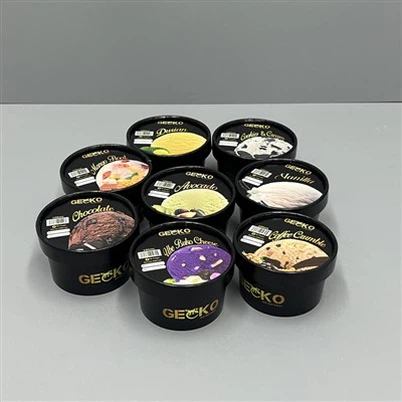

How Do You Order Custom Printed Ice Cream Cups Wholesale?
Leave a message
How Do You Order Custom Printed Ice Cream Cups Wholesale?
You're using plain, generic cups, which makes your brand invisible. Your competitors with custom cups look more professional, and you're missing a huge marketing opportunity.
The process involves finalizing your design on a template, choosing a certified supplier who meets your MOQ, understanding how volume lowers cost, and creating a design that acts as a powerful brand advertisement.

I once consulted for a growing gelato chain that was losing customers to a new competitor. Their product was better, but the competitor's branding was amazing. They had these beautiful custom printed cups that everyone was posting online. It made them look like a premium, established brand. My client realized their plain white cup was making their excellent gelato feel cheap. We immediately started the process of creating their own custom cups. It's more than just packaging; it's a statement about your quality and a key part of the customer experience. Let's walk through how you can do it right.
What are the steps for ordering custom cups in bulk?
The idea of a large custom order seems complex and overwhelming. You're worried about making a mistake with the design or timeline that could cost you thousands of dollars.
It's a straightforward four-step process: design consultation, quotation and proofing, mass production, and finally, logistics and delivery. Understanding this workflow prevents costly surprises and keeps your project on track.

I guide my clients through this exact process every day. The key is to be methodical and never rush the early stages, as that is where mistakes are most expensive. Think of it like building a house; you need a solid blueprint before you start laying bricks.
### Step 1: Design and Consultation
First, you finalize your logo, brand colors, and any text you want on the cup. I always recommend using Pantone (PMS) color codes to ensure the final color is perfect. My team then provides a "dieline template." This is a flat, 2D blueprint of the cup where your designer will place the artwork. It ensures everything lines up correctly when the cup is formed.
### Step 2: Quotation and Proofing
Once the design is ready, we provide a detailed quote based on the cup size, quantity, and number of colors. After you agree, you'll receive a digital proof (a PDF mock-up) to check for any errors. For any large order, I strongly recommend requesting a physical sample. Holding the actual cup in your hand is the only way to be 100% sure about the print quality and feel before we produce 50,000 of them.
### Step 3 & 4: Production and Delivery
After your final approval, we move to production which can take 15-30 days. The printed sheets are cut and formed into cups. Then comes logistics. For my international clients, we have to account for shipping time. Sea freight is economical but can take a month, while air freight is much faster but more expensive. This timeline must be factored into your inventory planning.
How do you choose the right wholesale supplier?
You find a very cheap supplier online, but you're not sure if they're reliable. Choosing the wrong partner could lead to unsafe materials, poor quality, and massive delivery delays.
A good supplier is a partner with food safety certifications like FDA or BRC. They should have high-quality printing capabilities, a reasonable MOQ for your business, and a solid, verifiable reputation.

Your brand's reputation is in your supplier's hands. This is not a place to cut corners. A low-quality cup that leaks or has smudged printing does incredible damage to how customers see your product. I've built my business on being a reliable partner, and here is the checklist I tell all my clients to use.
### Certifications Are a Must
This is non-negotiable. The supplier must have internationally recognized food safety certifications. This is your proof that the paper, ink, and coatings are non-toxic and safe for your customers. If a supplier cannot provide these certificates, walk away immediately.
### Technical Capabilities
Ask about their printing technology. For large runs, offset or flexographic printing offers the best quality and consistency. Can they match your Pantone colors exactly? Also, what is their Minimum Order Quantity (MOQ)? This is the smallest order they will accept. Make sure their MOQ fits your sales volume and storage space. A good partner will also offer different material options, like traditional PE coating or the eco-friendly PLA coating.
### Check Their Reputation
Look for reviews, testimonials, or case studies from other food and beverage brands. A professional supplier will be proud to show you their past work and connect you with happy clients.
What factors actually determine the cost of custom cups?
You've received a quote, but you don't understand why the price is what it is. You want to know how you can potentially lower the cost without sacrificing quality.
The per-cup price is mainly driven by order volume-more cups mean a lower price. Other key factors are the number of print colors, the cup's size and material, and shipping.

The single biggest factor in wholesale pricing is quantity. This is because there are fixed "setup costs" for every custom job, like creating the printing plates. Let's say the setup cost is $500. If you order 10,000 cups, that adds 5 cents to each cup. If you order 100,000 cups, it only adds half a cent to each cup. This economy of scale is huge.
Here is a breakdown of what influences your price:
| Factor | Impact on Cost | Why? |
|---|---|---|
| Order Volume | High | Spreads the fixed setup costs over more units, drastically lowering the per-cup price. |
| Number of Colors | Medium | Each color requires its own printing plate, adding to the setup costs. A 2-color design is cheaper than a 6-color one. |
| Cup Size & Material | Medium | Larger cups use more paper. Eco-friendly coatings like PLA cost more than standard PE. |
| Shipping Method | Variable | Air freight is fast but expensive; sea freight is slow but much cheaper. This affects your final landed cost. |
Understanding these factors allows you to make strategic decisions. For example, simplifying your design from five colors to three could lead to significant savings.
How can you design a cup that actually boosts your brand?
You have a blank canvas, but you're not a designer. You're worried about creating a design that looks cluttered, unprofessional, or is easily ignored by customers.
Keep it simple and bold. Use the entire 360-degree space for your message, maintain brand consistency with your colors and logo, and include a call to action like a social media hashtag.

Your cup is a mini-billboard. The goal is instant recognition. I've seen clients try to cram too much information onto a cup, and it just becomes visual noise. The most effective designs are often the simplest.
### Bold and Simple Wins
Remember, people will see your cup from across a room or in a quick photo on Instagram. A clean logo and a striking color scheme are far more effective than tiny text. It should be immediately obvious that the cup belongs to your brand.
### Use the Whole Canvas
Don't just put your logo on the front. The cup is a 360-degree experience. Use the back to display your website address, social media handles, or a fun brand slogan. This turns every cup into an informational tool.
### Add a Call to Action
This is a simple but powerful trick. Add a line like "Tag us in your photos! #MyAwesomeIceCream" to the cup. This encourages customers to generate free social media marketing for you. It invites them to become part of your brand's story. It's one of the best returns on investment you can get from your packaging.
Conclusion
A well-executed bulk order of custom cups balances design, cost, and a great supplier. This transforms your packaging from a simple expense into a powerful investment in your brand's growth.